Be the first to add a Sunglow Arctic Superconda photo.
Component genes
Your MorphDex
No one's shared a photo of this one yet. Own one? It can start your MorphDex.
Log in to start your MorphDexThe genetics
Albino
Albino is a recessive, amelanistic mutation in which melanin is absent entirely. The normal blotched pattern stays visible but loses all black pigment, leaving red, orange, or yellow tones with red eyes.
Hypo
(Evans/Dutch Hypo) — Hypo is a recessive, true hypomelanistic mutation that reduces rather than eliminates melanin. Dorsal blotches come out brighter and more saturated — often orange instead of brown — while the dark eyes are retained.
Arctic
Arctic is an incomplete-dominant gene that tends to brighten, clean up, and cool the overall appearance of a Western Hognose. Arctic animals often show a lighter base color, sharper contrast, cleaner pattern, brighter coloration, white outlines around pattern elements, and speckling/flecking compared to non-Arctic animals.
Anaconda x2
Superconda is the two-copy (super) form of the Anaconda gene — not a separate gene. It produces an extreme reduction in pattern on the body, often resulting in a nearly patternless or greatly simplified appearance. The head stamp remains. It occurs when a hognose inherits Anaconda from both parents.
What makes a Sunglow Arctic Superconda
- Two copies of Albino — recessive, so it only shows when paired up.
- Two copies of Hypo — recessive, so it only shows when paired up.
- Two copies of Anaconda — the 'Superconda' super form.
- One copy of Arctic — the single-gene Arctic form (incomplete dominant).
This describes the genetics of the animal itself — not the odds from a pairing. Outcome odds are the Genetics Calculator's job.
More in the Sunglow family
The same base with its Arctic and Anaconda modifier variants.
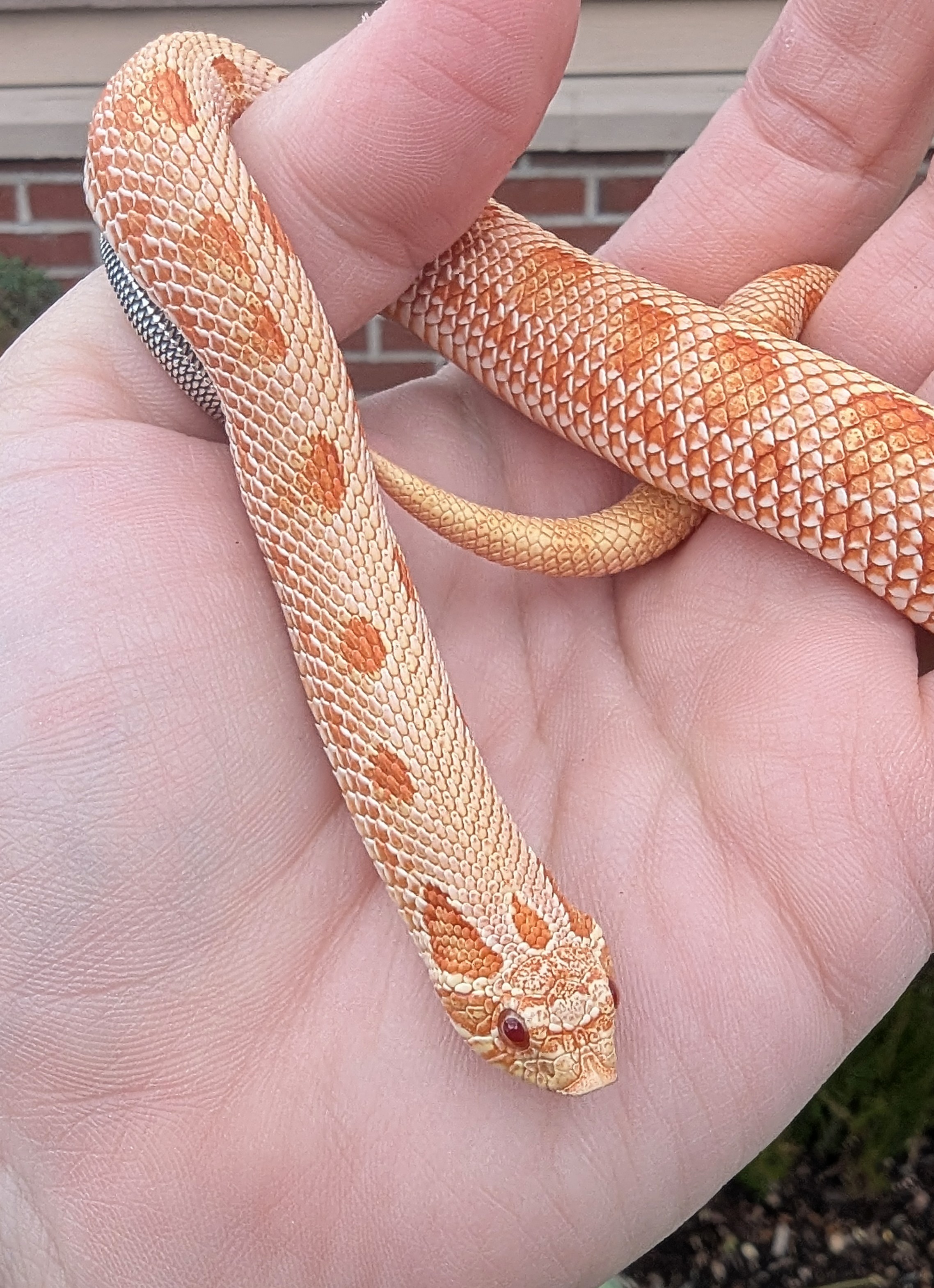
Be the first to add a Sunglow Arctic Superconda photo
Help build the Public Morph Guide — got a clear, full-body photo of a real one? Submit it and get credited. Every photo is reviewed before it appears.